


Research Areas
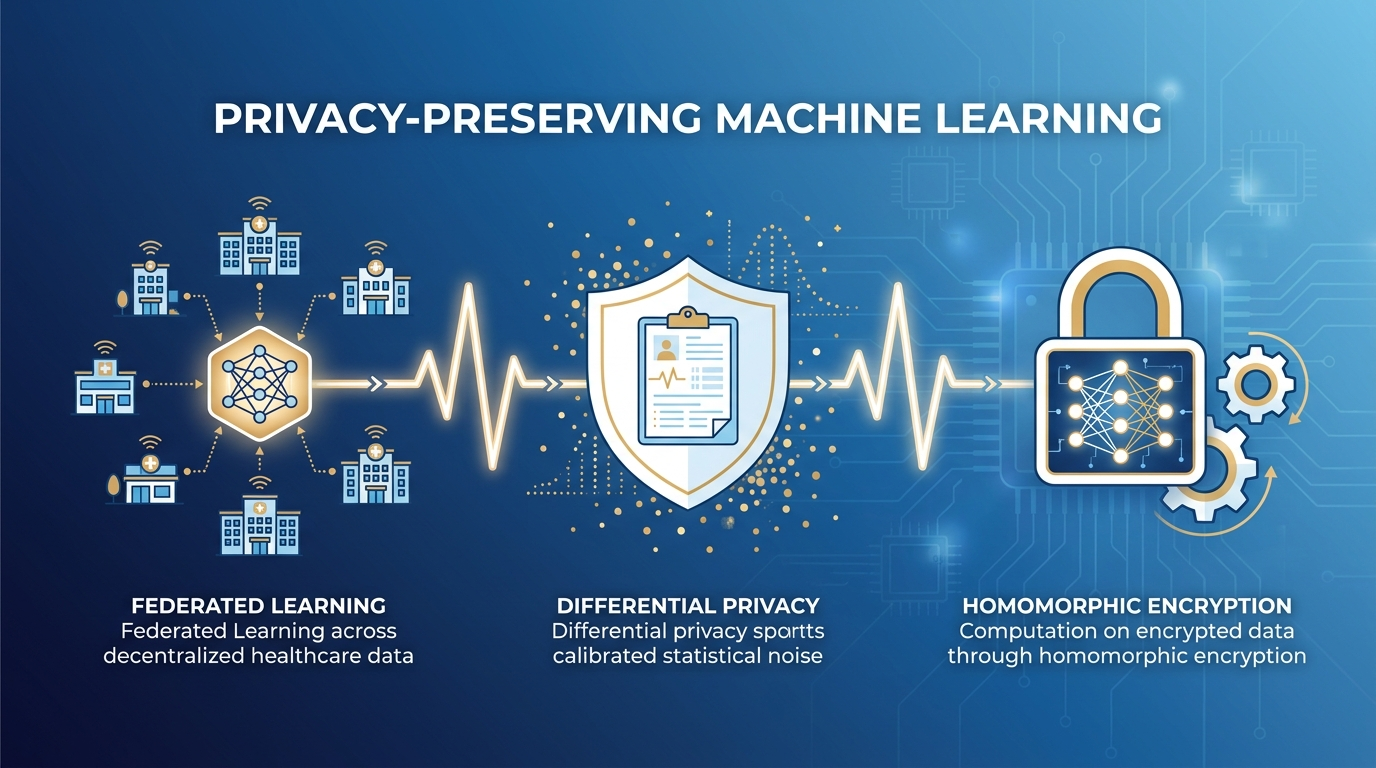
Privacy Preserving Machine Learning
Our research in privacy-preserving machine learning addresses the growing challenge of training and deploying ML models on sensitive data without compromising individual privacy. We investigate three complementary paradigms: Federated Learning (FL), which enables collaborative model training across decentralized data sources without centralizing raw data; Differential Privacy (DP), which provides formal mathematical guarantees against information leakage by introducing calibrated noise into the learning process; and Homomorphic Encryption (HE), which allows computation directly on encrypted data, ensuring that neither models nor intermediate results are ever exposed in plaintext. Current student projects supervised in the lab explore the application of these techniques to healthcare and other sensitive domains, examining the inherent trade-offs between privacy guarantees, model utility, and computational overhead in real-world settings.
|
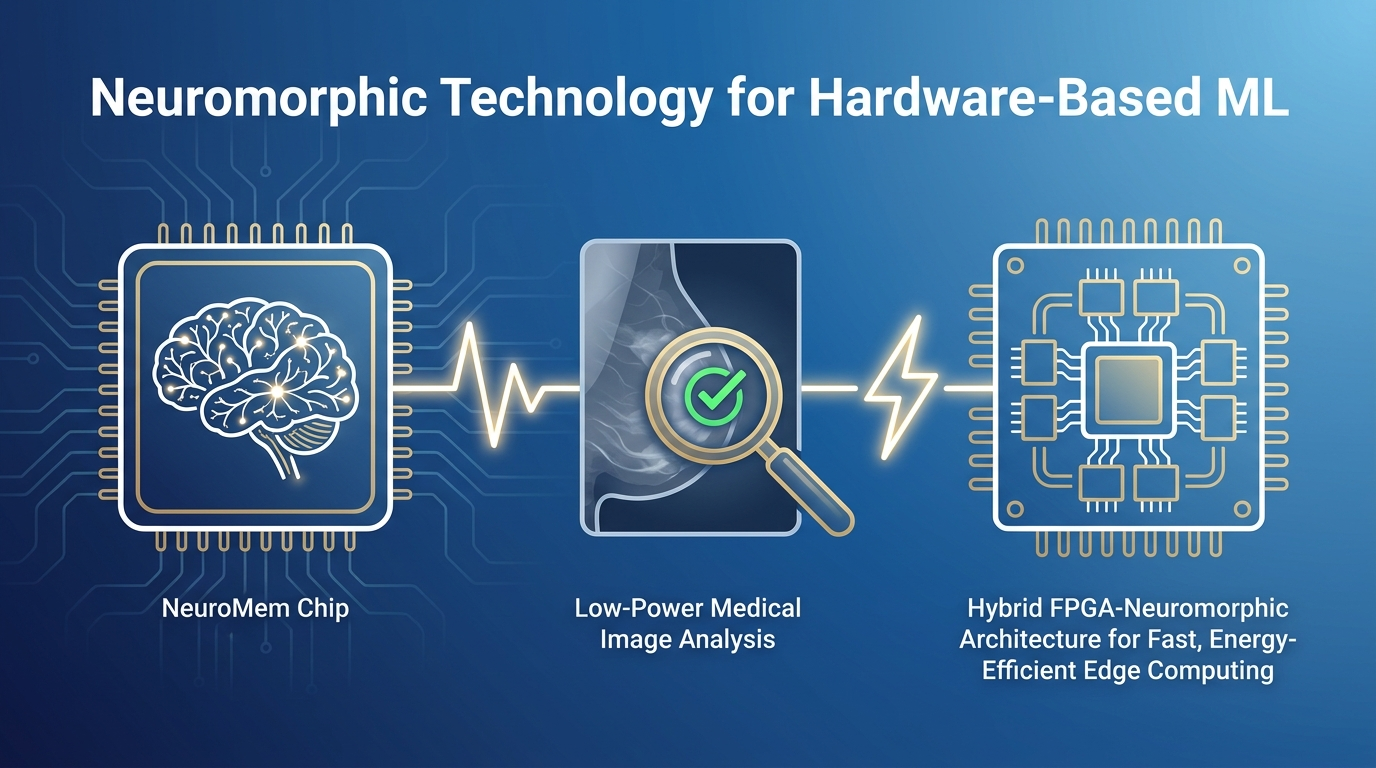
Neuromorphic technology for hardware-based ML
Our research explores neuromorphic hardware as an energy-efficient platform for deploying machine learning at the edge. Using the NeuroMem® chip, a massively parallel, brain-inspired neural network device, we have applied it to medical image analysis tasks such as breast cancer detection from mammograms, achieving competitive classification accuracy at a fraction of the power cost of conventional GPU-based systems. More recently, we developed a hybrid FPGA-neuromorphic architecture (PYNQ Z2 + NeuroShield) enabling fast, low-energy, and privacy-preserving image classification, well suited for sensitive edge-computing applications. This work addresses the fundamental challenge of running ML models on resource-constrained embedded systems by leveraging the inherent parallelism and low power footprint of neuromorphic hardware.
|
Evolutionary Computing and Neural Architecture Search
Our research in evolutionary computing and neural architecture search (NAS) studies how to automatically design machine learning models under real-world limits. We use evolutionary and hybrid optimization methods to balance different goals such as accuracy, speed, energy use, and model size. A key focus is making the search process efficient so it can explore large design spaces. We also work on improved search methods and ways to include hardware and deployment constraints directly into the optimization process.
|
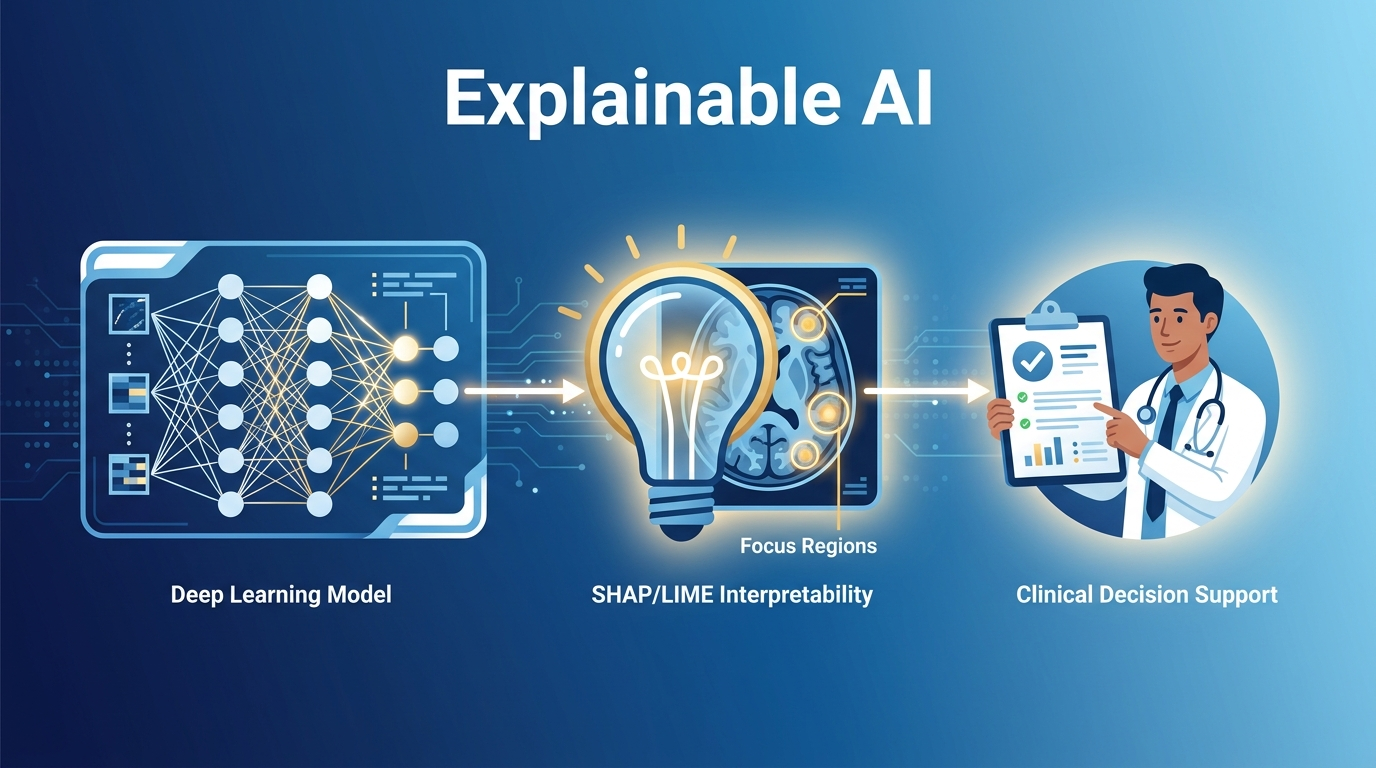
Explainable AI
Our research in explainable artificial intelligence (XAI) focuses on improving the transparency and interpretability of deep learning models in medical applications. In particular, we study how methods such as SHAP and LIME can be applied to convolutional neural networks to better understand predictions in areas like cancer classification and Alzheimer's disease detection. The goal is to develop reliable and interpretable models that support clinical decision-making while maintaining strong predictive performance.
|

Created Dataset:
|
|
Weed Stem Location from Overhead Imagery using Artificial Neural NetworksNexus Robotics developed a robust autonomous robot to work in outdoor agricultural settings to perform tasks such as the precision weeding of field crops. The goal was to provide affordable alternatives to costly human labor and environmentally damaging herbicides that were traditionally required to eliminate weeds from farmed crops. To achieve this, Nexus Robotics combined the latest in robotics, artificial intelligence, and power supply systems. A key aspect of their robotic solution was computer vision software components that could accurately identify objects from video images captured by the robot's camera(s). Nexus Robotics worked to identify the key computer vision problems and the best machine learning solutions that could be used. |

List of Published Papers:
Dr Lydia Bouzar-Benlabiod: Link to the Papers
Dr Andrew R. Mclntyre: Link to the Papers